What Does a Flight Attendant Actually Do All Day on a Dubai-Based Airline?
A realistic look at the pre-flight briefing, the safety checks, the meal service and the paperwork that fills a long-haul rotation out of Dubai.
Quick answer
- The GCAA cabin crew licence costs Dh1,700 and takes four working days, or two working days with a Dh200 fast-track fee (Khaleej Times, 2024-12-21)
- Emirates sets a minimum arm reach of 212 cm standing flat-footed, a minimum age of 21 at joining, and the ability to swim (HerAviationEra, undated)
- Expect to stand for most of a 7 to 14 hour sector, push loaded meal carts for two to three hours, and check lavatories about every 30 minutes
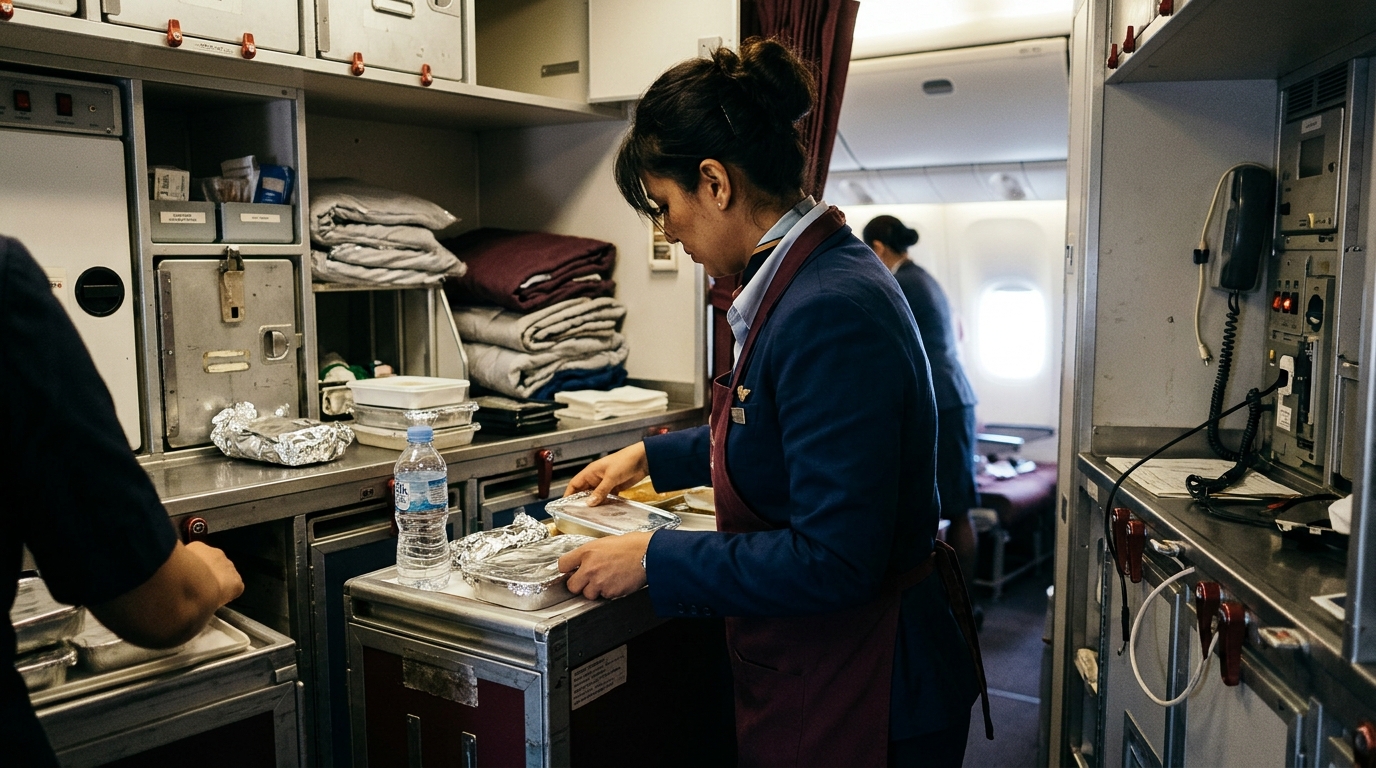
A Dubai-based flight attendant spends the working day on safety duties first and service second: a crew briefing, equipment checks at every door, boarding, meal and bar service, cabin patrols every 20 to 30 minutes, then reports and crew transport. Flying pay at Emirates is based on an average of 80 to 100 flying hours a month (HerAviationEra, undated).
It is legally a safety job. You cannot act as cabin crew on a UAE-registered aircraft without a valid licence issued by the GCAA showing you meet the specifications for your duties (General Civil Aviation Authority of UAE, undated).
Hour-by-Hour Breakdown
This is a long-haul departure from Dubai, roughly a 13-hour sector. Times shift with the roster — many Dubai rotations push back between midnight and 4am.
4:30 AM — Report and sign on. You scan in at the crew reporting centre and check your tablet for the passenger list, special meal counts and wheelchair requests. Grooming is checked here, including the no-visible-tattoos-in-uniform rule (cabincrew24.com, undated).
5:00 AM — Pre-flight briefing. The purser runs 20 to 30 minutes on cabin positions and door assignments, then fires safety questions you answer on the spot: oxygen bottle duration, door arming sequence, where the halon extinguishers sit on that aircraft type.
5:45 AM — Security and equipment checks. In your zone you check the defibrillator and medical kit seals, confirm life vests under seats, test the interphone, count oxygen bottles, and search seat pockets and overhead bins. Carts are cross-checked against the loading sheet.
6:15 AM — Boarding. About 40 minutes of greeting at the door, stowing oversized bags, re-seating families, counting heads and identifying able-bodied passengers at the exit rows.
7:00 AM — Doors, demo, take-off. Doors armed and cross-checked, safety demonstration, then a cabin secure check of every seatbelt, tray table and window shade before you take your jumpseat.
7:45 AM — First service. Drinks, hot towels, then the main meal. On a full wide-body that is two to three hours of continuous cart work, plus washing up and repacking carts to the loading plan.
10:30 AM — Cabin patrols and crew rest. With the cabin dark you walk the aisles every 20 to 30 minutes checking seatbelts, lavatories and anyone looking unwell. Your rest may be three hours in a windowless bunk.
4:00 PM — Second service and retail. A lighter meal, then duty-free sales and reconciling card takings against the stock sheet.
6:30 PM — Landing preparation. Cabin secure check, galley stowage, doors disarmed on the ground, farewells at the door.
7:30 PM — Debrief and transport. Incidents go into a cabin defect or occurrence report — a jammed recline, a broken oven, a passenger who refused to stow a bag. Then crew transport to the layover hotel, where a tax-free per-diem is paid for every layover (HerAviationEra, undated).
Tools and Equipment Used
- Crew tablet — rosters, seating and special meal lists, safety manuals
- Cabin interphone and PA handset — crew calls and announcements
- Door slide arming lever and viewing port — armed and cross-checked every departure
- Portable oxygen bottles and therapeutic masks
- Automated External Defibrillator (AED) and the onboard medical kit
- Halon and water fire extinguishers, smoke hood (PBE), fire gloves, crash axe
- Life vests, life rafts and emergency locator beacons — part of why the ability to swim is required (HerAviationEra, undated)
- Meal carts, bar carts and galley ovens — full carts are heavy and braked on inclines
- Hot towel tongs, wine keys and premium-galley espresso machines
- Card payment terminal for inflight retail
- Door and slide simulators and mock aircraft cabins — used throughout initial training in Dubai (Eton College, 2025-02-10)
- Emirates ID and passport — carried on duty and required for the GCAA licence file (Khaleej Times, 2024-12-21)
Work Environment and Pace
You work indoors in a pressurised cabin with dry air, constant engine and air-conditioning noise, and dimmed lighting for long stretches. You stand or walk for most of a seven to fourteen hour sector, seated only at the jumpseat for take-off and landing and during one crew rest break. Galleys are hot when the ovens run, and aisles are narrow enough that you turn sideways to pass a cart.
Flying hours average 80 to 100 a month (HerAviationEra, undated), but duty hours run longer once briefing, boarding and transport are counted. Rosters mix night departures, early reports and layovers eight or more time zones from Dubai, so body-clock disruption is constant rather than occasional.
The tedious parts are real. You clear trays smeared with food for roughly two hours after each main service, then wash and repack carts. You check lavatories about every 30 minutes on a long sector, which means mopping floors, restocking paper and dealing with blocked toilets and vomit. You lift cabin bags passengers cannot lift themselves several dozen times during a 40-minute boarding, and push loaded carts uphill when the aircraft sits nose-high. You also absorb complaints about seat allocation and delays you had no part in causing, on the fifth hour on your feet.
The offsetting package at Emirates includes free shared accommodation and transport to and from the airport in Dubai, plus a tax-free per-diem on each layover, in a country with no personal income tax (HerAviationEra, undated).
How to Get Started
- Check the baseline requirements first. Emirates asks for a minimum age of 21 at joining, a high school diploma or equivalent, the ability to swim, and a minimum arm reach of 212 cm standing flat-footed (HerAviationEra, undated). No visible tattoos are permitted in uniform (cabincrew24.com, undated).
- Get your English to B2 CEFR or above. That is the standard requirement for Emirates cabin crew (HerAviationEra, undated), and it is tested during recruitment.
- Build at least one year of hospitality or customer-service experience. It need not be airline or travel work (cabincrew24.com, undated) — hotel front desk, restaurant floor, retail or call-centre roles count.
- Attend an Open Day. Emirates recruitment starts there, followed by an invitation-only Assessment Day with a group assessment, an English test and a final interview (Global Training Aviation, undated). You do not need a passport to attend the assessment day; it is requested once you are offered the role (cabincrew24.com, undated).
- Complete initial training in Dubai. Emirates training runs approximately eight weeks, with recruits living in Dubai and using simulators and mock aircraft to cover safety and emergency procedures, customer service and cultural awareness (Eton College, 2025-02-10), delivered through e-learning, classroom and project work partly at the Emirates Centre of Hospitality Excellence (Emirates, undated).
- Complete the Basic Safety and Emergency Procedures (SEP) course and a Type Rating Course for your aircraft type. The Type Rating Course Certificate (Doc. Ref. TR01) covers safety and emergency procedures, cabin layout and equipment, and passenger safety and service (Khaleej Times, 2024-12-21).
- Apply for the GCAA cabin crew licence. It costs Dh1,700 and takes four working days, or two with a Dh200 fast-track fee (Khaleej Times, 2024-12-21). Prepare a passport copy, UAE visa copy, Type Rating Course Certificate, SEP certificate, Emirates ID and a recent colour photo to the stated specifications (Khaleej Times, 2024-12-21).
Frequently asked questions
How is Dubai cabin crew pay actually structured?
At Emirates it is described as a tax-free package of basic salary plus pay per flying hour, with a tax-free per-diem on every layover and free shared accommodation and airport transport in Dubai (HerAviationEra, undated). The flying-hour component is based on an average of 80 to 100 hours a month (HerAviationEra, undated), and the tax-free description comes from the UAE having no personal income tax (HerAviationEra, undated). Check the airline's own careers page for current figures.
Do I need a licence, or does the airline sort that out?
You need a valid GCAA-issued cabin crew licence to operate on a UAE-registered aircraft (General Civil Aviation Authority of UAE, undated). It costs Dh1,700, takes four working days or two with a Dh200 fast-track, and requires a Type Rating Course Certificate and a Basic SEP certificate first (Khaleej Times, 2024-12-21).
How long is training and where does it happen?
Emirates initial training is approximately eight weeks, with recruits living and training in Dubai and working in simulators and mock aircraft on safety and emergency procedures, customer service and cultural awareness (Eton College, 2025-02-10), partly at the Emirates Centre of Hospitality Excellence (Emirates, undated).
Is there hiring demand right now?
Emirates has approximately 22,000 cabin crew and has announced plans to recruit an additional 5,000 staff to meet rising travel demand (Aviation A2Z, 2024-11-18). No guide can promise you a job — recruitment runs through Open Days and invitation-only Assessment Days (Global Training Aviation, undated), and many applicants are not invited forward.
Sources
- General Civil Aviation Authority (GCAA) of UAE — Issue of Cabin Crew licence
- Khaleej Times — UAE: Want to be a cabin crew member? How to get required licence for the job (2024-12-21)

Written by
Khalid profiles workers and employers to find the human story behind job statistics. He favors long conversations over quick quotes and is skeptical of easy success narratives.