So You Want to Be Cabin Crew: Is It a Fit for You?
The job is safety work first and service second: pre-flight equipment checks, rostered night departures, and a licence that follows approved training.
Quick answer
- Most Emirates cabin crew earn AED 10,000 to AED 18,000 a month, roughly AED 120,000 to AED 216,000 a year depending on rank, flying hours and allowances (Aviation A2Z, 2026), while Glassdoor lists an average base of AED 8,667 a month for cabin crew in Dubai as of November 2026.
- No degree is formally required: the GCAA sets a licence minimum age of 18 and requires you to pass an examination after an approved initial training course (General Civil Aviation Authority (GCAA), UAE, undated), while the big UAE carriers typically ask for Grade 12 and a minimum joining age of 21 (Umbandando, 2026; Flight Attendant Central, 2026).
- Staying procedural under pressure predicts success — you run the emergency drill from memory; needing predictable sleep predicts frustration, because rosters mix night departures, 04:00 report times and standby.
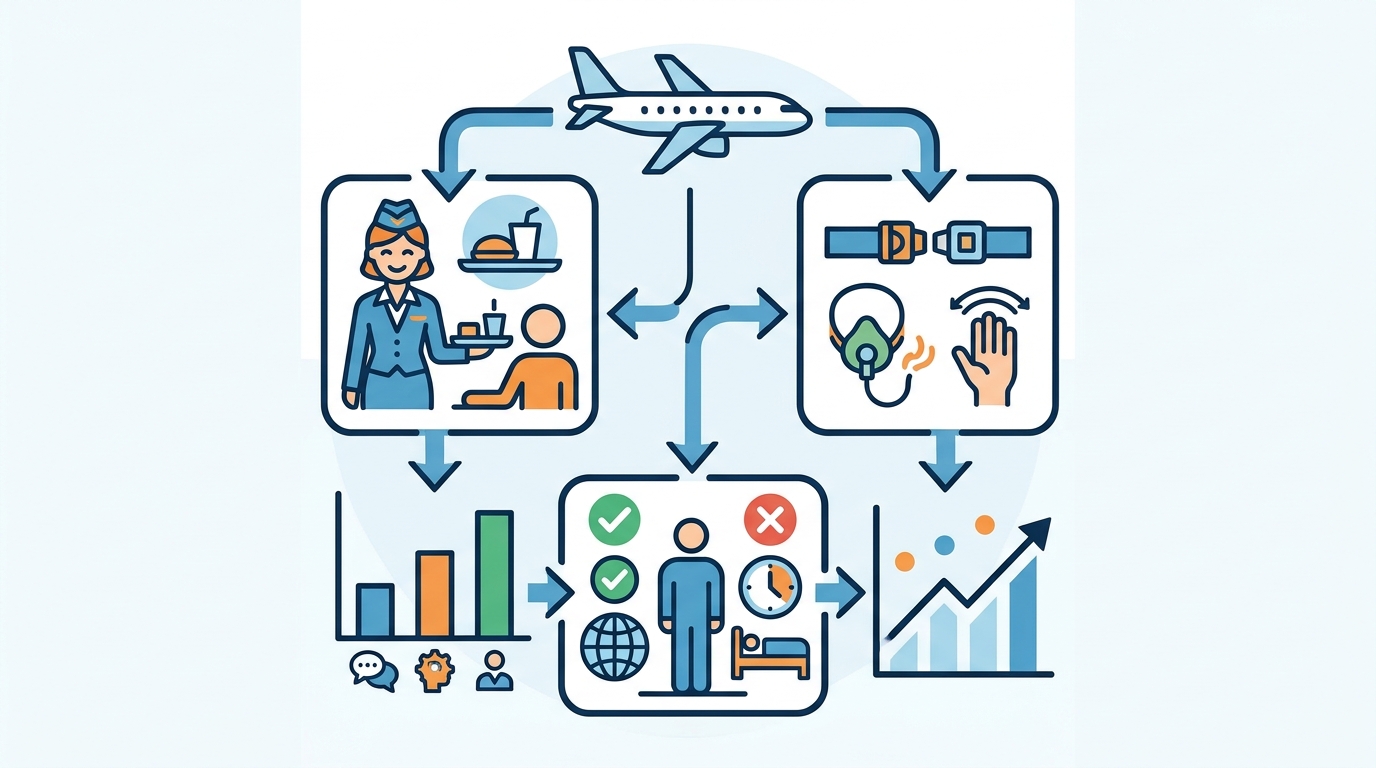
Cabin crew are safety staff who also serve food. In the UAE the role is licensed: the General Civil Aviation Authority requires a licence applicant to be at least 18 and to pass an examination after completing an approved initial training course (General Civil Aviation Authority (GCAA), UAE, undated), and crew are subject to a medical fitness assessment (GCAA via Sassofia summary of CAR Part I, undated).
Airlines then add their own bar on top — Emirates and Etihad both list a minimum joining age of 21 and Grade 12 education, among other criteria (Umbandando, 2026; Flight Attendant Central, 2026). Pay is usually a modest fixed basic plus hourly flying pay and allowances, so your monthly figure moves with your roster.
What You'd Actually Do Day to Day
A long-haul day out of Dubai or Abu Dhabi tends to run like this.
Morning, around two hours before report. You wake to an alarm set by your roster, not your body clock. You check the crew app on the company-issued tablet for roster changes, put on full uniform to the grooming standard, and take crew transport to the reporting centre. Briefing runs 30 to 45 minutes: the purser allocates positions and doors, then asks safety questions — door operation in manual versus automatic, where the portable oxygen bottles are, how many halon extinguishers are on board, the decompression drill. Answer badly and you can be stood down. Then crew security, immigration and the bus to the aircraft.
Pre-departure. You work the pre-flight safety and security check against the checklist: slide pressure gauges in the green, extinguishers sealed, defibrillator and medical kit present and intact, life vests under seats, crash axe and megaphone stowed. In the galley you count catering carts, test ovens and chillers, and reconcile duty-free and bar seals. Boarding: you greet, watch for anyone unwell or intoxicated, check that exit-row passengers can manage the door, and find bin space. Doors close, you arm your door and cross-check with the crew opposite, then run the safety demonstration or monitor the video.
Midday, at cruise. Bar run, hot meals out of the ovens, special meals matched to seat numbers, clear-up, cabin secure check. You take duty-free payments on the onboard POS terminal, answer the interphone and call bells, settle a seat dispute, and log defects — a dead IFE screen, a blocked lavatory. If a passenger falls ill you take observations, open the first aid kit, call the flight deck on the interphone and ask on the PA whether there is a doctor on board. On ultra-long sectors crew rest is rostered in blocks; you sleep in a bunk with the engine noise still there.
Afternoon and after landing. Second service, cabin secure, disarm and cross-check doors, disembark, file reports on anything that happened, clear immigration at the outstation and reach the hotel. Depending on the roster you are back at the airport in 24 hours, or home the same night after a turnaround.
Equipment you handle constantly: the tablet holding manuals and roster, the interphone and PA handset, galley carts, ovens and chillers, the payment terminal, the automated external defibrillator, oxygen bottles and smoke hoods, and the door arming lever.
Who Tends to Thrive in This Work
- Procedural calm — when an oven overheats or a passenger faints, you follow a memorised sequence while 300 people watch you.
- Physical reach and stamina — standards are built around reaching overhead equipment; Emirates uses an arm reach of 212 cm standing flat-footed as the operating standard rather than a strict height minimum (HerAviationEra, 2026), and Etihad is listed at a minimum height of 163 cm (Flight Attendant Central, 2026).
- Comfort delivering bad news politely — several times per flight you tell people their bag goes in the hold, their meal choice is finished, or they cannot move seats.
- Strong working English — one aggregator states the Emirates selection process runs entirely in English at a minimum proficiency equivalent to B2 or higher (Global Training Aviation, undated), and safety commands must land first time.
- Tolerance for being assessed — uniform and grooming checks, recurrent safety exams and onboard performance reviews are routine, and visible tattoos in uniform are not permitted at either Emirates or Etihad (Umbandando, 2026; Flight Attendant Central, 2026).
- Living well with strangers — you fly with a different crew most trips, share a hotel floor with people you met at briefing, and often live in shared company accommodation.
Who Tends to Struggle
- You need a fixed weekly schedule. Rosters include night departures, 04:00 report times and standby duties; Etihad explicitly asks for comfort with irregular rostered hours (Flight Attendant Central, 2026). Birthdays and Eid dinners land mid-trip more often than you expect.
- Standing and lifting bother your body. A service means pushing loaded carts down a narrow aisle and lifting bags into bins, mostly on your feet across a 12-hour sector. Crew face a medical fitness assessment under UAE regulations (GCAA via Sassofia summary of CAR Part I, undated), and the airline check covers general physical health, vision, hearing and fitness to perform safety duties (The Cabin Crew Forum, 2026).
- You take rudeness personally. On a delayed flight with a broken seat and no meal choice left, you absorb the complaints and still greet the next row. That load is cumulative across a four-sector day.
- You want to put down roots now. Based crew live where the airline bases them; if a partner's job or a child's school ties you to one city, the lifestyle fights you.
- You dislike repetition. Equipment checks, demo, service flow and secure checks follow the same sequence every flight by design — the variation is in passengers and destinations, not procedure.
What It Pays and Where It Leads
Gulf carrier pay is usually a fixed basic, plus hourly flying pay, plus per-diem allowances for nights away, often with accommodation and transport provided. Your monthly total therefore moves with the roster, so treat any single average with care.
| Experience Level | Typical Annual Pay | What Changes |
|---|---|---|
| Entry (new Grade II, Economy) | Basic of about AED 4,980 a month, from figures Emirates publishes on its careers website, plus flying pay of roughly AED 69.60 per flight hour on an example of 80 to 100 hours a month (MondoExpat, undated); another aggregator cites a basic near AED 4,430 and about AED 63 per hour, taking the monthly total past AED 10,000 (Global Training Aviation, undated) | Light months and short-haul rosters cut flying pay; layover allowances add to the basic |
| Mid (established crew, premium cabins) | AED 10,000 to AED 18,000 a month for most Emirates cabin crew, roughly AED 120,000 to AED 216,000 a year by rank, hours and allowances (Aviation A2Z, 2026); Glassdoor lists an average base of AED 8,667 a month in Dubai, range AED 5,000 to AED 10,000, from 1,065 salaries as of November 2026 | Higher grade, premium cabin work and bidding for long-haul sectors |
| Senior (Purser or Cabin Supervisor) | About AED 16,000 to AED 18,000 a month or more during busy long-haul operating periods (Aviation A2Z, 2026) | You run the briefing, allocate positions, manage onboard incidents and write the reports |
| Training and management | Not published in the sources above | A Head of Training at a cabin crew training organisation should hold cabin crew qualification for at least three years, one of them as a cabin crew instructor (General Civil Aviation Authority (GCAA), UAE, undated) |
Check live figures on the airline's own careers site and on UAE salary pages such as Glassdoor or Bayt before planning around any number, and confirm at offer stage what accommodation, transport and medical cover are included.
How to Get Started
- Check the hard criteria first. The GCAA sets the licence applicant minimum at 18 (General Civil Aviation Authority (GCAA), UAE, undated), but the big carriers go higher: Emirates lists minimum joining age 21 and Grade 12 (Umbandando, 2026), Etihad lists 21, Grade 12 or equivalent and a minimum height of 163 cm (Flight Attendant Central, 2026), while another listing gives Etihad 160 cm plus the ability to swim with a flotation device (Cabin Crew Academy, 2025). Measure your arm reach against a wall — Emirates uses 212 cm (HerAviationEra, 2026).
- Close the gaps you can close. Finish Grade 12 or an accepted equivalent. Take a recognised English test and practise speaking if selection runs entirely in English at B2 or above (Global Training Aviation, undated). Learn to swim with a flotation device if your target airline requires it.
- Take a customer-facing job that creates evidence. Apply for hotel front desk agent, airport passenger service agent with a ground handler, or luxury retail sales associate roles in Dubai, Abu Dhabi or Sharjah, and write down specific examples: the complaint you resolved, the shift you covered, the safety incident you reported. Assessors ask for these by name.
- Build the application pack to airline spec. A one-page CV, a formal full-length photo and a close-up portrait in the format the careers portal asks for, plus scanned passport, certificates and reference letters. Both Emirates and Etihad state visible tattoos in uniform are not permitted (Umbandando, 2026; Flight Attendant Central, 2026), so check placement before you apply.
- Apply through the airline's own careers site and attend an open day. Expect a CV drop, group exercises, an English assessment, the reach test and a final one-to-one across several rounds. Emirates has around 22,000 cabin crew and has announced plans to recruit a further 5,000 staff to meet rising travel demand (Aviation A2Z, 2024).
- Pass the medical, then the training exam. Crew face a medical fitness assessment under UAE regulations (GCAA via Sassofia summary of CAR Part I, undated), covering physical health, vision, hearing and fitness for safety duties (The Cabin Crew Forum, 2026). A UAE licence is only issued after you pass the examination following an approved initial training course (General Civil Aviation Authority (GCAA), UAE, undated); Etihad runs this at its Zayed Campus in Abu Dhabi, covering Safety and Emergency Procedures, first aid, service across all cabin classes, and brand and grooming standards (The Cabin Crew Forum, 2026).
Frequently asked questions
Do I need to pay for a cabin crew course before I apply?
The licensing requirement is that you pass an examination after completing an approved initial training course (General Civil Aviation Authority (GCAA), UAE, undated) — and with the major UAE carriers that training is run by the airline after hiring, as Etihad does at its Zayed Campus in Abu Dhabi (The Cabin Crew Forum, 2026). Private pre-application courses are optional and are not a substitute for the airline's own programme. Read the airline's careers page before paying anyone.
Is there a height requirement, or is it about reach?
It depends on the airline, and published accounts differ. One listing of Emirates requirements gives a height of at least 160 cm with an arm reach of 212 cm on tiptoes (Umbandando, 2026), while another says Emirates has no formal minimum height and uses 212 cm reach standing flat-footed (HerAviationEra, 2026). Etihad appears as 163 cm in one source (Flight Attendant Central, 2026) and 160 cm in another (Cabin Crew Academy, 2025), so verify on the carrier's own page.
How much will I actually take home in my first year?
Expect a modest fixed basic plus hourly flying pay. For new Grade II Economy crew the basic is cited at about AED 4,980 a month from figures Emirates publishes on its careers website, with flying pay near AED 69.60 per flight hour across 80 to 100 hours a month (MondoExpat, undated); another aggregator cites about AED 4,430 basic and AED 63 an hour, taking the total past AED 10,000 (Global Training Aviation, undated). Because hours vary, ask at offer stage how flying hours are allocated and what accommodation and transport are provided.
Will tattoos stop my application?
Both Emirates and Etihad state that visible tattoos in uniform are not permitted (Umbandando, 2026; Flight Attendant Central, 2026). That is an employer grooming standard rather than a civil aviation rule, so it varies between airlines and between countries. If you have tattoos, check the specific carrier's policy on placement and coverage before investing time in the application.
Sources
- General Civil Aviation Authority (GCAA), UAE — CAR–CC Cabin Crew Licence and Training, Issue 01
- General Civil Aviation Authority (GCAA), UAE — CAR-CC Cabin Crew Training Requirements, Attestations and Licences, Issue 03
Written by
Reema untangles the rules, sponsorships, and contracts that shape who can work where and under what terms. She writes plainly about systems that are usually explained in jargon.