Is a Career in Nursing Right for You in the UAE?
A look at the shift patterns, licensing exams and ward realities behind nursing in Dubai, Abu Dhabi and the Northern Emirates before you commit.
Quick answer
- Published pay estimates disagree sharply: SalaryExpert puts the average registered nurse in Dubai at AED 253,515 a year as of 17 November 2026, while Indeed's aggregated data (22 September 2025) shows AED 5,404 a month for a Nurse in the UAE — check both, and current vacancies, before you budget.
- The practical entry route is a nursing degree, DataFlow primary source verification, a valid BLS certificate and a regulator exam — DHA's Registered Nurse paper is 150 MCQs in 3 hours at a Prometric centre (prometricmedical.com, undated) — with Abu Dhabi's DOH also asking for a BSN and 2 years' post-qualification experience (healthbridge.ae, undated).
- People who thrive double-check a dose calculation at hour nine of a shift without resenting it; people who struggle are usually those who need fixed evenings and weekends, because ward rotas run nights, Fridays and public holidays.
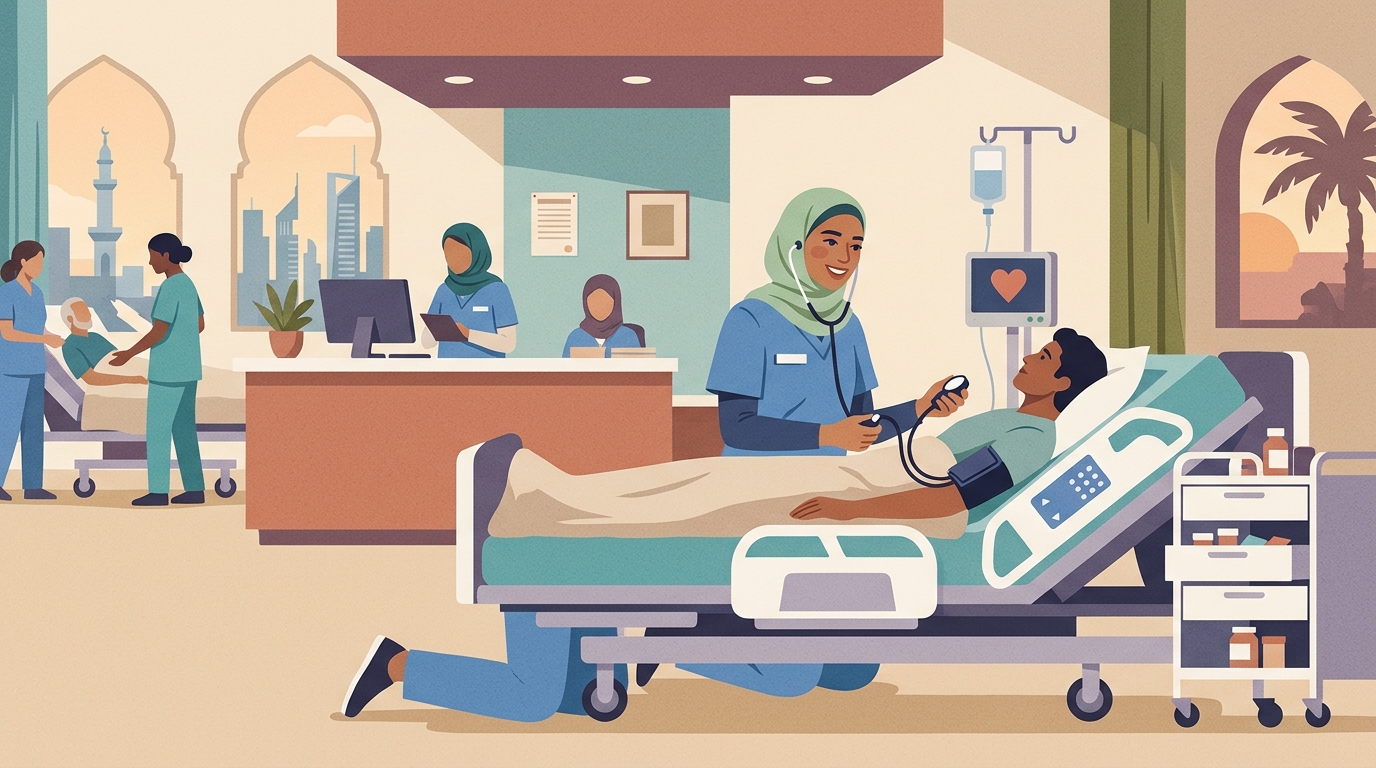
Nursing in the UAE is clinical work wrapped in a licensing process. Before you take a bedside job you must pass a regulator's exam — DHA in Dubai, DOH in Abu Dhabi, or MOHAP in the Northern Emirates — and have your degree verified through DataFlow, which all three require (nursehubgcc.com, undated). The work suits people who can hold a calm voice and an accurate medication chart while four things happen at once.
Pay reporting varies widely between sources, entry requirements differ between emirates, and shifts sit inside the UAE's 8-hour day rule. This guide covers a typical shift, the traits that predict success or frustration, what the published pay figures actually say, and the order to do things in if you are starting from zero.
What You'd Actually Do Day to Day
Take a medical-surgical ward in a Dubai hospital. You arrive 15 minutes early for handover.
Morning. You take report from the night nurse, structured as SBAR, for each assigned patient, then log into the electronic medical record (EMR) for overnight observations, pending labs and the medication administration record. Your first round is vital signs from the patient monitor, pain scores, IV cannula sites checked for phlebitis, and infusion pumps reprogrammed where rates have changed. The 08:00 drug round follows: scan wristbands, draw up doses, countersign controlled drugs with a second nurse, chart each administration before moving to the next bed. A diabetic patient needs a glucometer reading and a sliding-scale insulin decision escalated to the doctor.
Midday. Consultant ward rounds. You summarise each patient in under a minute, take new orders, then spend an hour turning them into actions — bloods drawn, a urinary catheter removed, a referral logged, a discharge summary started. You chase pharmacy for a missing antibiotic, and reposition two immobile patients on a pressure-area schedule, documenting the skin assessment.
Afternoon. Admissions arrive from the emergency department: full assessment, falls risk score, allergy check, care plan entry. A patient deteriorates, so you escalate and work the crash trolley with the resuscitation team, using the Basic Life Support certification your licence requires you to hold (interface.edu.pk, undated). Then the incident note, the rest of your charting, restocking the trolley, and handover to the evening shift.
Shift length sits under Federal Decree-Law No. 33 of 2021, which sets maximum normal working hours at 8 hours a day or 48 a week (UAE Legislation, 2021), reduced by 2 hours daily during Ramadan (U.AE, undated). In practice that means rotating shifts including nights and weekends, set by your employer's rota.
Who Tends to Thrive in This Work
- Tolerance for repetitive precision — you will do the same medication double-check hundreds of times a month, and the hundredth has to be as careful as the first.
- Willingness to escalate early — when a blood pressure drops at 03:00, the nurse who calls the on-call doctor straight away does better than the one who waits to look sure.
- Documentation discipline — every assessment, drug and refusal goes into the EMR within the shift, and those notes are audited.
- Cross-cultural communication — UAE wards mix patients and colleagues from many countries, and you will explain pre-op fasting instructions to someone who does not share your first language.
- Patience with bureaucracy — licensing runs through DataFlow primary source verification for DHA, DOH and MOHAP (nursehubgcc.com, undated), and you will chase documents from your home-country council.
- Appetite for specialising — DOH recognises titles including Critical Care Nurse, Emergency Nurse, Pediatric Nurse, Oncology Nurse, Dialysis Nurse and Mental Health Nurse, each needing a postgraduate specialty certificate (enursingportal.com, undated).
Who Tends to Struggle
- You need your evenings fixed. Nights, Fridays and public holiday shifts are allocated by roster, not preference, so a weekly evening class or second job will collide with it.
- You want a licence before you move. DHA licence activation requires a job offer from a DHA-licensed employer in Dubai, and you must be present in the emirate to complete that step (felixhappich.com, undated).
- Exam pressure unsettles you. The DOH Registered Nurse exam is 150 MCQs in 3 hours (interface.edu.pk, undated), and after three failed attempts you can reapply only once you hold an additional recognised certificate or qualification (enursingportal.com, undated).
- You carry grief home. You may nurse a patient for a week, then perform last offices and speak to the family the same shift, and still chart the next admission.
- You dislike interruption. A drug round gets broken by call bells, a phone call from radiology and a relative's question, and you have to resume without losing your place in the chart.
What It Pays and Where It Leads
Published figures for UAE nursing pay disagree, largely because of sample size, job title and whether housing and transport allowances are counted. Treat the table as a map of the sources, not a quote, and check current vacancies with regulator-licensed employers.
| Experience Level | Typical Annual Pay | What Changes |
|---|---|---|
| Entry (0-3 years, Staff Nurse) | SalaryExpert puts entry level (1-3 years) in Dubai at AED 180,651 a year as of 17 November 2026; healthbridge.ae (undated) quotes monthly Staff Nurse bands of AED 7,000-12,000 in Dubai (DHA), AED 6,500-11,000 in Abu Dhabi (DOH) and AED 5,500-9,000 in the Northern Emirates (MOHAP/SHA) | A general ward or clinic caseload under supervision, night rotations and competency sign-offs |
| Mid (3-8 years, specialty or charge nurse) | SalaryExpert gives a Dubai registered nurse average of AED 253,515 a year as of 17 November 2026; Indeed's aggregated data shows AED 5,404 a month for the Nurse title (22 September 2025) and AED 3,052 a month for Registered Nurse (undated) | A postgraduate specialty certificate opens DOH-recognised titles such as Critical Care, Emergency, Oncology or Dialysis Nurse (enursingportal.com, undated), plus precepting new staff |
| Senior / Lead (8+ years, Nurse Manager) | SalaryExpert lists senior level (8+ years) in Dubai at AED 287,822 a year as of 17 November 2026; healthbridge.ae (undated) quotes Nurse Manager/Director at AED 18,000-28,000 a month in Dubai | Rota building, staffing budgets, accreditation audits, incident investigation, less bedside time |
Averages that pool assistant, practical and registered nurse roles pull the number down, so compare like with like: same emirate, same title, same licence.
How to Get Started
- Complete a nursing degree, ideally a BSN. DOH asks for a BSN from a recognised institution, or a diploma with substantial experience assessed case by case, plus a minimum of 2 years post-qualification clinical experience (healthbridge.ae, undated). MOHAP Registered Nurse vacancies in Sharjah, Ajman, Fujairah, Ras Al Khaimah and Umm Al Quwain commonly ask for an MOH licence, a BSc Nursing and 2+ years of experience (jobsorces.com, undated).
- Decide which regulator to target first. The UAE unified PQR sets no minimum post-qualification experience for Registered Nurses and Assistant Nurses applying for a DHA licence, provided your practice gap is not more than 2 years (interface.edu.pk, undated). A long career break blocks you; a short CV may not.
- Gather the two documents that stall most applications. A valid Basic Life Support (BLS) certificate is part of DHA licensing requirements (interface.edu.pk, undated), and DHA applicants also need a Good Standing Certificate from their home-country nursing council issued within the last 6 months (prometricmedical.com, undated). Request the latter early.
- Submit your credentials to DataFlow for primary source verification, which DHA, DOH and MOHAP all require (nursehubgcc.com, undated). The full DHA route from DataFlow through the Prometric exam is described as a realistic 8 to 16 week timeline (prometricmedical.com, undated).
- Book and sit the licensing exam. The DHA Registered Nurse paper is 150 single-best-answer MCQs in 3 hours at any Prometric centre worldwide (prometricmedical.com, undated); the DOH exam is a computer-based test of 150 MCQs in 3 hours (interface.edu.pk, undated), with that step taking about 2-4 weeks including preparation once eligibility is confirmed (healthbridge.ae, undated).
- Apply for Staff Nurse and Registered Nurse vacancies with licensed employers, using hospital and clinic careers pages alongside Bayt, GulfTalent, Indeed UAE and LinkedIn, filtering by the licence the employer names. DHA activation needs the offer plus your presence in Dubai (felixhappich.com, undated), so plan travel around the offer stage.
- Pick a specialty within your first two contracts. Study for a postgraduate certificate aligned to a DOH-recognised title such as Critical Care Nurse, Emergency Nurse or Dialysis Nurse (enursingportal.com, undated), and ask your unit manager to rotate you into that area while you study.
Frequently asked questions
Can I work anywhere in the UAE with one nursing licence?
Each regulator covers its own territory: DHA for Dubai, DOH for Abu Dhabi, and MOHAP for Sharjah, Ajman, Fujairah, Ras Al Khaimah and Umm Al Quwain (jobsorces.com, undated). Moving between emirates generally means dealing with the relevant regulator again, though all three require the same DataFlow primary source verification of your credentials (nursehubgcc.com, undated). Check the current rules on the regulator's own portal before planning a move, as processes change.
Do I need experience before applying, or can I come straight from graduation?
It depends on the emirate. Under the UAE unified PQR, Registered Nurses and Assistant Nurses need no minimum post-qualification experience for a DHA licence as long as there is no practice gap of more than 2 years (interface.edu.pk, undated). Abu Dhabi's DOH is stricter, asking for a BSN plus a minimum of 2 years post-qualification clinical experience (healthbridge.ae, undated), and MOHAP vacancies commonly list 2+ years as well.
How long does the whole licensing process take?
For the DHA route, from DataFlow verification through to the Prometric exam, 8 to 16 weeks is described as realistic (prometricmedical.com, undated). For Abu Dhabi, the exam step alone is put at 2-4 weeks including preparation once eligibility is confirmed (healthbridge.ae, undated). Slow home-country paperwork — such as the Good Standing Certificate DHA requires to have been issued within the last 6 months (prometricmedical.com, undated) — is the usual cause of delay.
Why do the salary figures I find online vary so much?
Titles and samples differ. Indeed's aggregated data shows AED 5,404 a month for "Nurse" from 1.1k reported salaries (22 September 2025) but AED 3,052 a month for "Registered Nurse" from 2.1k salaries (undated), while GulfTalent's AED 3,500 a month, ranging from AED 2,500 to AED 8,500, rests on just 39 nurses registered with the site (undated). SalaryExpert's Dubai average of AED 253,515 a year is dated 17 November 2026. Ask any employer whether housing and transport are included before comparing offers.
What happens if I fail the licensing exam?
Both the DHA and DOH Registered Nurse papers are 150 MCQs in 3 hours (prometricmedical.com and interface.edu.pk, undated), so timed practice matters as much as content revision. For DOH, failing three attempts means you can reapply only after obtaining an additional recognised certificate or qualification (enursingportal.com, undated). Treat the first attempt as the one that counts rather than a trial run.
Sources
- prometricmedical.com — DHA License for Nurses 2026: Requirements and Fees
- interface.edu.pk — DHA Nursing Exam Requirements 2026: Nurses and Midwives
Written by
Farida steers the publication's coverage of hiring trends across the Gulf's shifting job market. She is drawn to the gap between what job ads promise and what workplaces actually deliver, and pushes writers to chase that gap down.