
How to Become a Nurse in the UAE: Step-by-Step
Licensing runs through DOH, DHA, SHA or MOHAP depending on the emirate, and each stage — DataFlow, exam, job offer — has to happen in the right order.
Quick answer
- Fastest legitimate route: finish a recognised nursing degree or diploma, start DataFlow verification, pass the regulator's assessment, then let an employing facility submit the licence application.
- Allow roughly 3 to 4 years for a Bachelor of Science in Nursing, then about 3 to 9 months for verification, exam and licensing — longer if documents are slow to arrive from your training institution.
- The most common entry mistake is applying for jobs before DataFlow and the regulator assessment are complete.
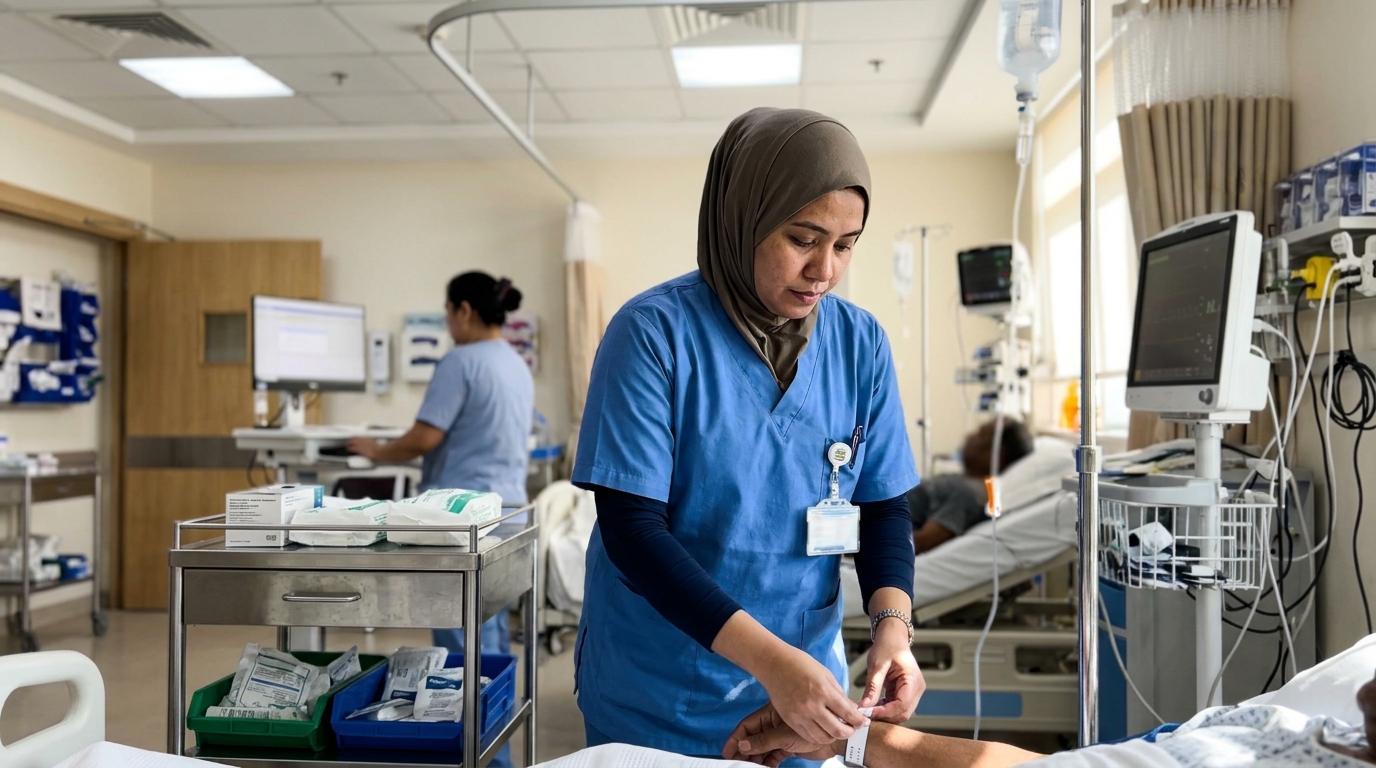
Nursing in the UAE is a licensed profession, so the route runs through a health regulator before it runs through a job board. You need a nursing qualification, DataFlow verification of your documents, a regulator assessment or exam, and an employing facility to submit the licence application. Which regulator you deal with depends on where you want to work: the Department of Health Abu Dhabi (DOH), the Dubai Health Authority (DHA), Sharjah Health Authority (SHA), or the Ministry of Health and Prevention (MOHAP) for the northern emirates.
The work itself is shift-based and protocol-driven: medication rounds against an electronic chart, observations at set intervals, admission and discharge documentation, and handover at each shift change.
Entry Requirements at a Glance
Requirements differ by emirate, so check the regulator where you intend to work. A DOH licence is valid only within Abu Dhabi and does not automatically permit practice in Dubai or the northern emirates (Neelim, undated).
| Requirement | Typical Minimum | Notes on Exceptions |
|---|---|---|
| Education (Registered Nurse) | Bachelor's degree in nursing, minimum three years' full-time study, under the current Professional Qualification Requirements (Pabau blog, undated) | Mandatory, not merely preferred. A diploma plus substantial experience may be assessed case by case for a DOH licence (HealthBridge, undated) |
| Education (Assistant Nurse) | Nursing diploma of not less than 18 months (Pabau blog, undated) | A separate licence category. MOHAP licensing also covers nursing assistants, registered midwives and assistant midwives (MOHAP, undated) |
| Post-qualification experience | Varies by regulator and rules edition. A fresh-graduate Registered Nurse with a Bachelor's needs none under PQR Version 3 (Neelim blog, undated) | Earlier editions required two years of post-registration clinical experience (Neelim blog, undated). MOHAP states at least two years, with a work-record gap of no more than two years (MOHAP, undated); DOH is described as two years post-qualification (HealthBridge, undated) |
| Background verification | A DataFlow report returning 'positive' or 'not verified' for MOHAP (MOHAP, undated) | Mandatory. DataFlow Group is an independent private company verifying degree, transcripts, nursing council registration and work experience (CareerPort HR blog, undated) |
| Regulator assessment or exam | Pass the relevant assessment; the DOH Prometric computer-based test is separate from the DHA and MOHAP exams (HealthBridge, undated) | Mandatory. A MOHAP assessment certificate is valid for five years (MOHAP, undated) |
| Good standing and conduct | Certificate of Good Standing from your home-country nursing regulator, dated within a stated window — examples include PRC (Philippines), NMC or state council (India), NMC (UK) (HealthBridge, undated) | Mandatory. MOHAP also requires a certificate of good conduct (MOHAP, undated) |
| Job offer and submission | A written job offer from a licensed facility | For MOHAP, the facility — not you — logs in via UAE PASS and submits the application; the Ministry approves, then the facility pays the fee (MOHAP, undated). Other documents include the assessment certificate, employer experience certificates, passport and Emirates ID copies (MOHAP, undated) |
| Continuing education | Minimum annual CME/CPD hours set in the Unified Healthcare Professional Qualification Requirements (DHA, undated) | Mandatory for renewal; DHA renewal requires nurses to complete a set number of CME hours per year (DrExpat blog, undated) |
The Path Step by Step
- Confirm your licence category (1 to 2 weeks). Read the Unified Healthcare Professional Qualification Requirements, published jointly by DOH, DHA and SHA, which sets qualification, experience and CME requirements for nursing licensure (DHA, undated). Decide whether you are applying as a Registered Nurse or an Assistant Nurse; the education minimums differ (Pabau blog, undated).
- Complete the qualifying nursing programme (18 months to 4 years). A Bachelor's degree of at least three years' full-time study for Registered Nurse, or a diploma of not less than 18 months for Assistant Nurse (Pabau blog, undated). Before you graduate, ask your registrar how it handles third-party verification requests — that matters at step 4.
- Register with your home-country regulator and request a Certificate of Good Standing (4 to 12 weeks). Issuing bodies include the PRC in the Philippines, the NMC or state nursing council in India, and the NMC in the UK, and the certificate must be dated within a stated window (HealthBridge, undated). Request it close to the time you apply.
- Submit DataFlow primary source verification (1 to 3 months, longer if institutions are slow). DataFlow Group independently confirms your degree, transcripts, nursing council registration and work experience before any Gulf health authority processes a licence application (CareerPort HR blog, undated). For MOHAP, the report must return 'positive' or 'not verified' (MOHAP, undated).
- Get your Eligibility Letter and book the exam through Prometric (2 to 8 weeks). DHA requires DataFlow verification first, then issues an Eligibility Letter allowing you to book through Prometric (CareerPort HR blog, undated). For Abu Dhabi, the DOH Prometric test is a separate exam from the DHA and MOHAP ones (HealthBridge, undated).
- Sit and pass the assessment (1 day, plus 4 to 8 weeks of study). Clearing the DOH Abu Dhabi exam produces an Eligibility Letter valid for a stated period, during which you can apply to medical facilities across the emirate (iPass Processing blog, undated). A MOHAP assessment certificate is valid for five years (MOHAP, undated).
- Apply to licensed facilities and secure a written offer (1 to 6 months). Work hospital and clinic careers portals directly, and search UAE job boards such as Bayt, GulfTalent and LinkedIn with the emirate name in the query, so you do not chase a Dubai post holding only an Abu Dhabi eligibility. Attach your eligibility letter or assessment certificate.
- Let the employer file the licence, then start your CME record (2 to 8 weeks after offer, then ongoing). Under MOHAP's process the facility submits via UAE PASS, the Ministry approves, and the facility pays the fee; MOHAP publishes the application and licence fees on its service page (MOHAP, undated). From your first month, file every CME certificate in one folder for renewal (DHA, undated).
Skills to Build Before You Apply
- Take and interpret a full set of vital signs — blood pressure, pulse, respiratory rate, temperature, oxygen saturation — and know the thresholds at which you escalate to the shift in-charge.
- Perform medication administration safely, including weight-based paediatric dose and infusion-rate calculations you can explain without a calculator shortcut.
- Document a complete nursing admission assessment and a shift note in an electronic health record, in English, within the time a real shift allows.
- Give a structured handover using SBAR (situation, background, assessment, recommendation) in under three minutes.
- Hold current Basic Life Support certification, and Advanced Cardiac Life Support if you are targeting ICU, emergency or cardiac wards.
- Demonstrate infection prevention practice: hand hygiene moments, donning and doffing PPE, aseptic non-touch technique for IV cannula and catheter care.
- Assemble your documents pack early — degree certificate, transcripts, nursing council registration, dated employer experience certificates for every role, passport copy — because DataFlow verifies exactly these items (CareerPort HR blog, undated).
- Work through your regulator's exam blueprint with timed practice question sets, since the DOH test is separate from the DHA and MOHAP exams (HealthBridge, undated).
Mistakes That Slow People Down
- Applying for jobs before DataFlow is complete. Gulf health authorities will not process a licence until verification of degree, transcripts, nursing council registration and work experience is done (CareerPort HR blog, undated). The fix: start verification as soon as you decide on the UAE, and chase your university registrar and former employers yourself.
- Letting a gap in the work record grow. MOHAP's conditions require at least two years of experience, with a gap of no more than two years (MOHAP, undated). The fix: if you are on a break, take a clinical post — even part-time ward or clinic work at home — and get a dated employer experience certificate for it.
- Sitting the wrong regulator's exam. The DOH Prometric test is separate from the DHA and MOHAP exams (HealthBridge, undated), and a DOH licence covers only Abu Dhabi (Neelim, undated). The fix: choose the emirate first, sit that regulator's exam, then filter job searches by emirate.
- Assuming you can file your own MOHAP licence. The employing facility logs in via UAE PASS and submits, and pays the fee after Ministry approval (MOHAP, undated). The fix: at offer stage, ask the facility's licensing coordinator who submits and when.
Frequently asked questions
How much does the licensing process cost?
There are several separate payments: DataFlow verification, the Prometric exam booking, and the regulator's fees. MOHAP publishes both the application fee and the licence fee on its nursing and medical professional licensing service page (MOHAP, undated), so check current amounts there. Under the MOHAP process, the employing facility pays the licence fee after the Ministry approves the application (MOHAP, undated).
Can I get licensed as a fresh graduate with no hospital experience?
It depends on the regulator and the edition of the rules in force. One secondary guide reports that under PQR Version 3 a fresh-graduate Registered Nurse with a Bachelor's needs no post-qualification experience to be assessed, while earlier editions required two years post-registration (Neelim blog, undated). MOHAP's own conditions state at least two years (MOHAP, undated), and DOH is described as two years post-qualification (HealthBridge, undated). Confirm against the current Unified Healthcare Professional Qualification Requirements (DHA, undated).
I trained as a nurse abroad — can I transfer my registration directly?
No regulator accepts a foreign registration on its own. You still need DataFlow primary source verification of your degree, transcripts, nursing council registration and work experience (CareerPort HR blog, undated), a Certificate of Good Standing from your home regulator such as the PRC in the Philippines or the NMC in the UK (HealthBridge, undated), and a pass in the relevant UAE exam (HealthBridge, undated).
What keeps the licence valid once I have it?
Continuing education. The Unified Healthcare Professional Qualification Requirements set minimum annual CME/CPD requirements for nursing licensure (DHA, undated), and DHA renewal requires nurses and pharmacists to complete a set number of CME hours per year (DrExpat blog, undated). A MOHAP assessment certificate is valid for five years (MOHAP, undated), so track that date too.
Sources
- Ministry of Health and Prevention (MOHAP) — License for Nursing and Medical Professionals
- Dubai Health Authority (DHA) — Unified Healthcare Professional Qualification Requirements (PQR)

Written by
Priya turns hiring numbers and salary surveys into readable stories about where opportunity is actually moving. She cares most about separating genuine shifts from recruiter spin.