Flight Attendant: Signs the Daily Work Fits You
A look at the galley hours, safety drills and body-clock costs behind the trolley, plus what UAE-based airlines ask for before you can apply.
Quick answer
- You can stay on your feet for a whole long sector and push a full meal trolley up a sloping aisle
- Sleeping in daylight and eating a main meal in the middle of the night doesn't wreck you for the next duty
- Clearing other people's trays and checking lavatories several times a flight is part of the job you accept
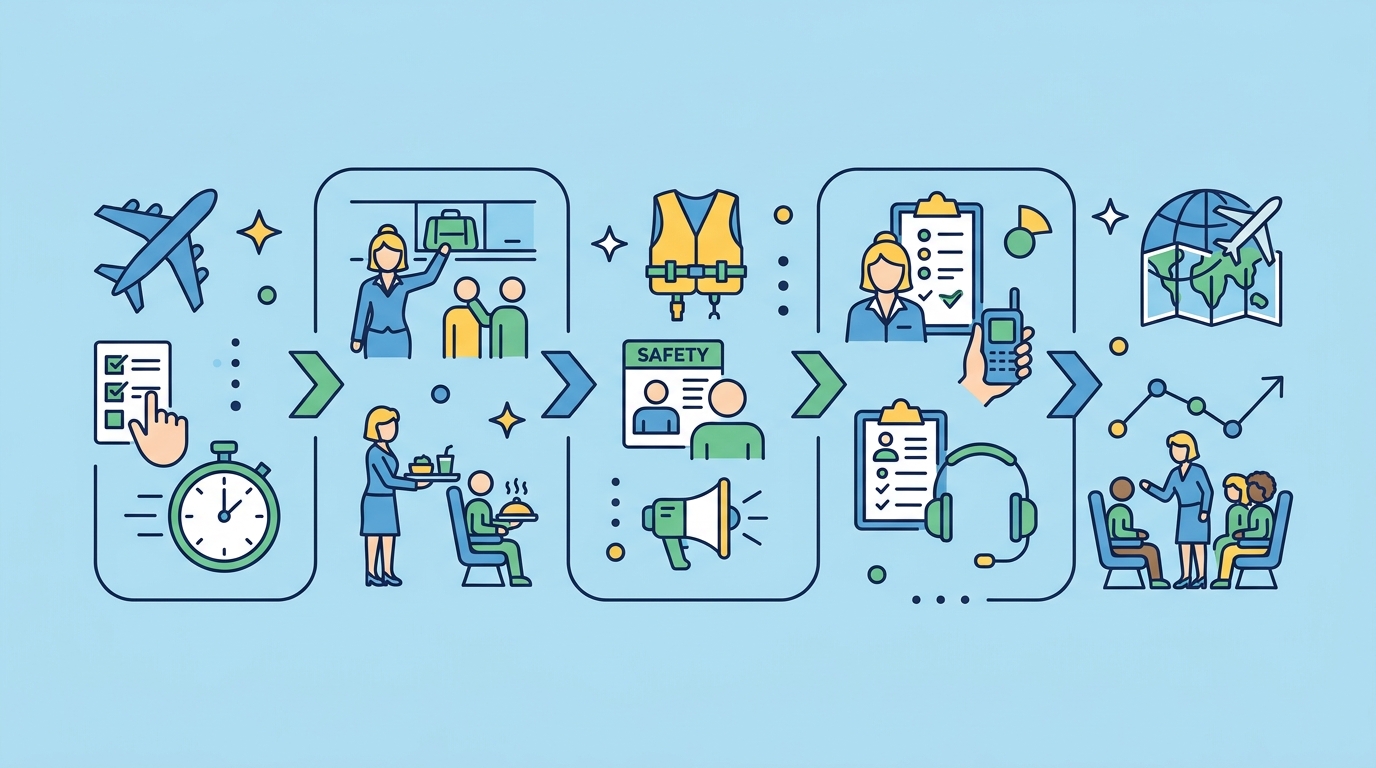
Cabin crew work is a safety job wrapped in a service job. Most of a duty is spent on your feet in a narrow aisle — pushing loaded meal trolleys, lifting bags into overhead bins, walking cabin checks and clearing trays — with firefighting, medical and evacuation training sitting underneath all of it.
It suits people who can switch from pouring coffee to managing an unruly passenger in seconds, who sleep well in daylight, and who accept a monthly roster. Requirements differ by airline and country, so check each airline's own careers page.
Signs This Role Suits You
- You can stand and walk a narrow aisle for a full long sector in uniform shoes, then run a second service before descent.
- Reaching and closing overhead bins repeatedly doesn't strain you. Emirates asks candidates to be at least 160cm tall and able to reach 212cm high (Emirates Group Careers, undated); other airlines set their own height and reach tests.
- You can deliver the pre-takeoff safety demonstration — life vest, seat belt, oxygen mask, exit pointing — with full attention on every departure, including the last one of a busy week.
- Emergency detail sticks in your head. Safety and Emergency (SEP) training covers aircraft equipment, firefighting, in-flight emergencies and evacuation procedures (Emirates Group Careers, undated).
- Blood and bodily fluids don't freeze you. Group Medical Training covers CPR, bleeding, burns and emergency childbirth (Emirates Group Careers, undated), and you may be the only trained responder on board.
- You can calm someone who has just been refused another drink. Security training covers preventing and managing unruly behaviour, hijacking, sabotage and personal security (Emirates Group Careers, undated).
- Strict grooming rules don't bother you: Emirates requires no visible tattoos in uniform, and the uniform includes the red hat and cream scarf, with alternative head coverings not part of the current uniform (Emirates Group Careers, undated).
- You're happy sharing a home. Emirates provides furnished accommodation free of charge, with two or three colleagues of the same gender sharing an apartment — your own bedroom, shared kitchen and living area (Emirates Group Careers, undated).
What a Typical Day Involves
Rough shares of a long-haul outbound duty. Short sectors compress the same sequence and repeat it several times a day.
- 10% — pre-flight briefing and safety checks. In the hour before boarding: crew briefing, then checking Halon extinguishers, protective breathing equipment, portable oxygen bottles, slide pressure gauges and the demo kit at your assigned door.
- 15% — boarding. Greeting at the door, directing seat rows, lifting and re-stowing cabin bags overhead, briefing exit-row passengers.
- 5% — departure and arrival checks. The safety demonstration, cabin secure check and seat-belt sweep before every takeoff and landing, strapped into the jumpseat for taxi.
- 35% — meal and bar service. The largest block: loading galley ovens, assembling trolleys, running a full service down the aisle, then a second service before descent.
- 15% — cabin and lavatory checks. Walkthroughs at the interval set in your airline's manual, usually two to three times an hour on a long sector, plus tidying lavatories, restocking supplies and compacting rubbish.
- 10% — passenger requests and paperwork. Blankets, formula bottles, seat swaps, duty-free sales and logbook entries, spread across the flight.
- 10% — crew rest and galley reset. Rostered rest in a bunk or blocked seat, then re-stowing carts, completing disembarkation paperwork and handing over the cabin.
The Downsides Nobody Mentions
The physical environment wears at you in a low-grade way. Cabin air is dry and the engine hum means you raise your voice for an entire service, so a sore throat after a run of sectors is normal rather than a sign of illness. You're on your feet for most of a long flight, pushing a loaded trolley up a cabin that tilts in the climb, and lifting passengers' cabin bags overhead during every boarding. Ankles swell. Crew rest is a bunk or a blocked seat, not a bed in a quiet room.
The low-status tasks are unavoidable: checking lavatories several times a flight, clearing trays of half-eaten food into a cart by hand, and mopping up after airsick passengers. Nobody else does it for you.
Then there's the schedule. Emirates cabin crew work to a monthly roster with approximately eight days off per month in Dubai (Emirates Group Careers, undated) — you learn your nights and weekends a few weeks ahead. All employees are on probation for the first six months of service, after which they become eligible for leave (Emirates Group Careers, undated), so an early trip home can be hard to arrange. New crew fly supernumerary after graduation so performance can be observed before their first operational flight (Emirates Group Careers, undated), and once joined, additional medicals are conducted for the residence visa and to comply with GCAA requirements (Emirates Group Careers, undated). Medical fitness is a condition of the job, not a one-off hurdle.
How to Get Started
- Check the baseline requirements against yourself. Emirates asks for a minimum age of 21, at least high school (Grade 12) education, fluency in written and spoken English with additional languages an advantage, at least one year of hospitality or customer service experience, a height of 160cm with a 212cm reach, no visible tattoos in uniform, and the ability to meet the UAE's employment visa requirements, with the role based in Dubai (Emirates Group Careers, undated). Other Gulf, European and Asian carriers set different criteria — read each airline's own page.
- Get the customer-facing experience on your CV. Common routes are hotel front desk agent, food and beverage server, barista, retail sales associate or airport passenger service agent. Shift-based roles help, because they show you can work nights and early starts.
- Work on swim and reach fitness. Most airlines test swimming ability for ditching drills and check your reach flat-footed or on tiptoe, depending on the carrier.
- Apply through the airline's own careers site or an open day. Bring a printed CV and photographs in the format each airline specifies, and expect a group assessment, a reach check and a final interview.
- Plan for full-time training before you fly. New Emirates recruits complete an intense period of safety and service training at a facility in Dubai (Emirates Group Careers, undated), covering SEP, Group Medical, security and a Service Learning Experience in facilities simulating the A380 and B777 cabins (Emirates Group Careers, undated).
- Understand how the money is structured before you accept. Emirates cabin crew pay is made up of a fixed basic salary, hourly pay for operated flights and an overseas meal allowance (Emirates Group Careers, undated). Hourly-based pay means a light roster month pays less, so check current rates and benefits directly on the airline's careers page.
Frequently asked questions
Do I need a degree to become cabin crew?
Not for Emirates — the stated minimum is high school (Grade 12) education plus at least one year of hospitality or customer service experience, and fluency in written and spoken English (Emirates Group Careers, undated). Education requirements vary by airline and country.
How much time off will I actually get?
Emirates cabin crew work to a monthly roster with approximately eight days off per month in Dubai, and all employees are on probation for the first six months of service, after which they become eligible for leave (Emirates Group Careers, undated). Rosters and leave rules differ by airline.
How long before I can be promoted?
High-performing Emirates cabin crew have been able to attain the position of Flight Purser within five years (Emirates Group Careers, undated). Before that, new crew fly supernumerary after graduation so their performance can be observed ahead of their first operational flight.
Sources
- Emirates Group Careers — Cabin Crew | Emirates Group Careers

Written by
Khalid profiles workers and employers to find the human story behind job statistics. He favors long conversations over quick quotes and is skeptical of easy success narratives.