Cybersecurity Analyst: What the Work Is Really Like in the UAE
A look at shift handovers, alert queues and audit deadlines in Gulf security teams — plus the traits that make the queue bearable or unbearable.
Quick answer
- Pay is published with junior, mid and senior bands by Jobicy (2026-09-21) and as a 25th-to-90th-percentile total compensation range by levels.fyi (2026-04-02), while the Indeed Dubai and Abu Dhabi averages (2025-09-08) each rest on only two self-reported salaries — compare before you quote a number.
- No licence is legally required to work as an analyst; several UAE universities offer BSc and B.Tech cybersecurity degrees covering networks, cryptography, penetration testing and forensics (Fateh Education, 2026-09-24), and certification is commonly preferred rather than mandatory (Fateh Education, 2026-09-24).
- Tolerance for repetition predicts success, because you triage variations of the same phishing and failed-login alerts every shift; needing visible finished output predicts frustration, because a good week often means nothing happened and you have only closed tickets to show.
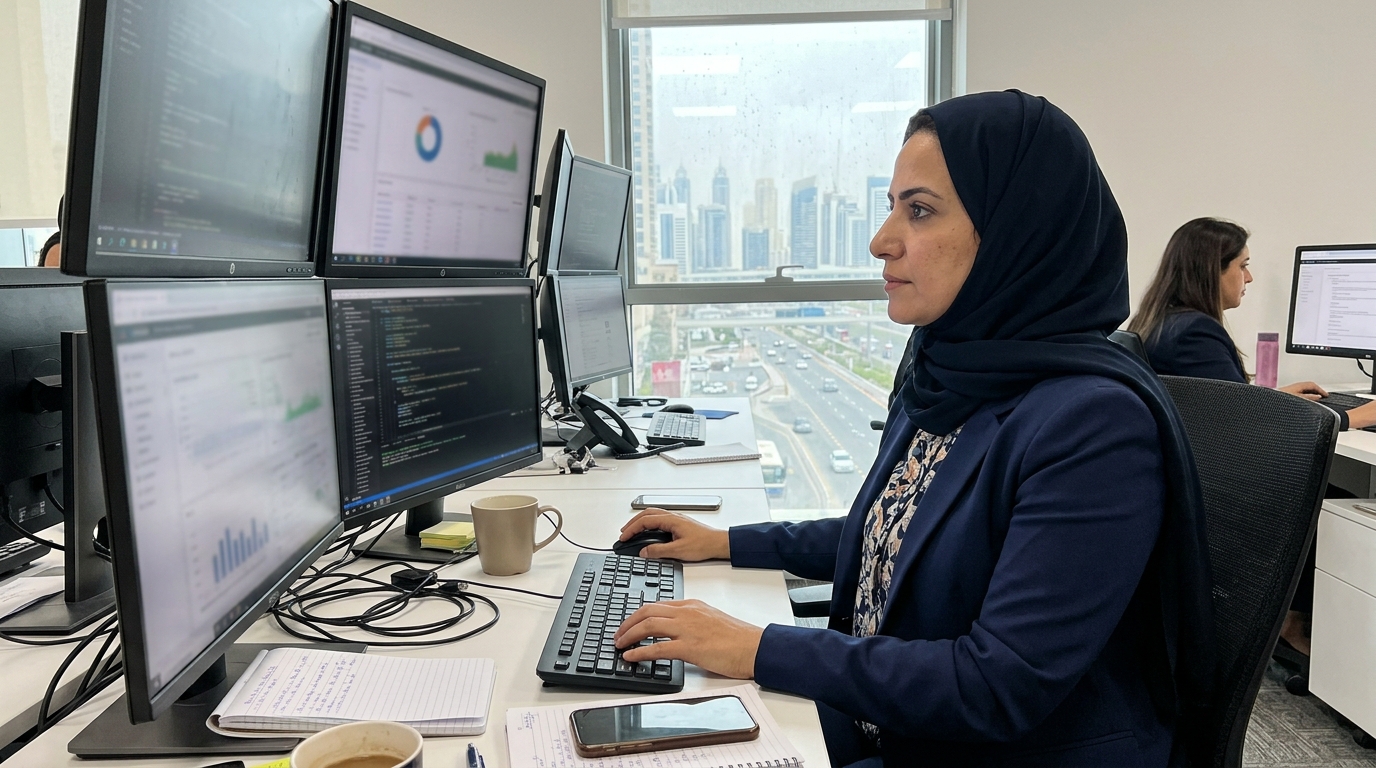
A cybersecurity analyst in the UAE spends most of the day inside a queue: SIEM alerts, phishing reports forwarded by staff, vulnerability scan results and compliance evidence requests. The work suits people who enjoy patient investigation punctuated by short bursts of pressure, and frustrates people who want to build things rather than check them.
UAE employers increasingly prioritise certified cybersecurity professionals (Fateh Education, 2026-09-24), and published pay figures differ sharply by source and method, so compare at least two trackers before you negotiate.
What You'd Actually Do Day to Day
Morning. You join the shift handover call, usually 20 minutes, where the outgoing analyst walks through what is still open: a suspicious PowerShell execution on a finance laptop, two unresolved impossible-travel logins. You open the SIEM console — Microsoft Sentinel and Splunk are both common in UAE enterprises — and work the overnight queue from highest severity down. Most alerts close in under ten minutes: an admin ran a script, a user travelled, a scanner tripped a rule. For the ones that don't, you pivot into the EDR console for the process tree, check file hashes against VirusTotal, and look for the same hash elsewhere in the estate.
You also work the phishing mailbox. Staff forward anything odd, and in a 3,000-person organisation that is dozens of messages a day. You check headers, detonate attachments in a sandbox, and if a campaign is live you raise a ticket to block the sender domain at the mail gateway.
Midday. Documentation, which is most of the job nobody mentions. Every investigation is written up in ServiceNow or Jira with timestamps, affected hosts, actions taken and the MITRE ATT&CK technique you mapped it to. In regulated sectors such as banking or aviation, that write-up exists partly because an auditor will read it later. You may also pull compliance evidence: patch status, exported user access lists, scan reports from Nessus or Qualys.
Afternoon. Project work, if the queue allows — tuning a noisy detection rule so it stops firing on a legitimate backup job, testing a rule against historical logs, or running Wireshark over a packet capture from a segment behaving strangely. Once or twice a month there is a tabletop exercise walking through a ransomware scenario.
Schedules vary by employer. In-house corporate teams often run business hours with an on-call rota; managed security service providers and bank SOCs in Dubai and Abu Dhabi usually run 24/7 rotating shifts, including nights and public holidays. Ask which model applies before accepting anything.
Who Tends to Thrive in This Work
- Patience with repetition — you close near-identical brute-force and phishing alerts for hours, and the one that matters looks almost exactly like the 200 that didn't.
- Written clarity under time pressure — your incident notes may be read by a manager who was asleep, an auditor a year later, and sometimes a regulator.
- Curiosity about how systems work — tracing why a login succeeded from an unexpected IP means understanding authentication flows, proxies and VPN egress, not just reading the alert text.
- Comfort delivering inconvenient news — you tell a department head their server needs patching this weekend, and you tell a senior executive that they clicked the link.
- Steadiness during escalation — in a live incident, three people message you at once and you still confirm containment before reporting it.
- Willingness to keep studying — UAE employers increasingly prioritise certified professionals, with mid-level roles seeking particular certifications and senior roles valuing additional credentials (Fateh Education, 2026-09-24).
- Tolerance for shift work in a SOC — night rotations and handovers are the baseline in 24/7 teams, including during Eid and national holidays.
Who Tends to Struggle
- People who need to build and ship. A week where you triaged 180 alerts and found nothing malicious feels wasted, even though it is a good outcome.
- People who dislike night and weekend rotation. A 24/7 SOC in Dubai or Abu Dhabi typically runs 12-hour rotating shifts; you work through holidays your friends have off.
- People who take conflict personally. Recommend blocking a widely used file-sharing tool and the business unit relying on it will push back, sometimes loudly, and you hold the position with evidence.
- People who freeze on ambiguous evidence. Logs are often incomplete, and you may have to isolate a laptop at 02:00 knowing you might be wrong and might disrupt a colleague's work.
- People expecting fast promotion out of the queue. Tier 1 triage can last 18 months to two years before a move into detection engineering, incident response or GRC.
What It Pays and Where It Leads
Published figures differ sharply depending on who collected them. Some trackers rest on a handful of self-reported salaries; others are estimates built from job adverts. Check at least two of the sources below yourself, and note that salaries here are not subject to personal income tax under the current framework (Fateh Education, 2026-09-24), which changes how an offer compares to one abroad.
| Experience Level | Typical Annual Pay | What Changes |
|---|---|---|
| Entry / Tier 1 SOC Analyst | Compare the junior band from Jobicy (2026-09-21), the starting salary Edoxi lists for Dubai (2025), the entry-level range from Security Infinity (undated) and the entry-level figure cited by Nucamp (undated) | You work a queue someone else built, escalate rather than decide, and follow written playbooks; shift work is common |
| Mid-level Analyst / Security Engineer | Compare the mid-level band from Jobicy (2026-09-21), the mid-level engineer and consultant range from Security Infinity (undated), and the Dubai and Abu Dhabi SOC monthly ranges reported by Fateh Education (2026-09-24) | You tune detections, lead smaller investigations and own a domain such as email security; certifications begin to gate roles (Fateh Education, 2026-09-24) |
| Senior / Lead | See the senior band from Jobicy (2026-09-21), the 25th-to-90th percentile total compensation range for the Greater Dubai Area on levels.fyi (2026-04-02), and the Senior Security Consultant average from PayScale (2026) | You set detection strategy, present to risk committees and mentor Tier 1; Nucamp (citing PayScale, undated) reports senior consultants with 10–19 years' experience also receive a bonus range |
| Head of Security / CISO | Not reliably published per role; negotiate against total compensation rather than base averages | Budget ownership, board reporting and regulatory accountability; Nucamp (undated) places CISO at the top of the UAE cybersecurity pay scale |
Two other factors shape earnings. Credentials: Nucamp (undated) notes earnings can rise sharply with experience and certifications such as CISSP and CCNP Security. Residency: the UAE Golden Visa now prioritises AI and cybersecurity experts, offering 10-year renewable residency without employer sponsorship, with eligibility requiring a minimum monthly salary, a relevant degree and a valid UAE employment contract (Fateh Education, 2026-09-24). Confirm current criteria through official UAE government channels rather than a recruiter's summary.
How to Get Started
- Build the underlying IT skills first. Learn TCP/IP, DNS, Active Directory and the Linux command line until you can explain what a failed Kerberos authentication means. Analysts who skip this stall at pasting alert text into a search engine.
- Choose a formal or self-study route knowingly. No licence is legally required to work as an analyst in the UAE; a degree is what many employers prefer. Several UAE universities run BSc and B.Tech cybersecurity programmes covering networks, cryptography, penetration testing and forensics (Fateh Education, 2026-09-24). With an existing IT degree, certification plus a home lab is usually faster.
- Build a lab and document three investigations. Run a free-tier SIEM in a cloud trial, ship logs from two virtual machines, generate suspicious activity, then write each case up: what fired, what you checked, what you concluded, which MITRE ATT&CK technique it maps to. Publish the three write-ups on a public repository or blog and send that to recruiters.
- Get certified, because UAE employers screen on it. Employers here increasingly prioritise certified professionals, with mid-level roles seeking particular certifications and senior roles valuing additional credentials (Fateh Education, 2026-09-24). Start with a vendor-neutral foundation certification and plan towards credentials associated with higher earnings, such as CISSP and CCNP Security (Nucamp, undated).
- Apply for the actual entry titles. Target Tier 1 SOC Analyst, Security Engineer and Network Security Engineer (Nucamp, undated), and Information Security Analyst roles. Search LinkedIn, Bayt, GulfTalent and NaukriGulf, and apply directly to managed security service providers, which hire in volume for shift coverage.
- Rehearse the one interview question that decides it. You will be asked to walk through an alert end to end. Practise a five-minute answer aloud from one lab write-up: the alert, your first three checks, the evidence that changed your mind, the containment decision, what you would tune afterwards.
- Take the shift role if it comes first. Twelve to eighteen months on a rotating SOC rota gives you case volume no lab reproduces, and it is the standard route into detection engineering, incident response or governance.
Frequently asked questions
Do I need a cybersecurity degree to get hired in the UAE?
No law requires one, and many analysts cross over from IT support, networking or systems administration. What is common rather than mandatory is a relevant degree plus certification; several UAE universities offer BSc and B.Tech cybersecurity programmes covering networks, cryptography, penetration testing and forensics (Fateh Education, 2026-09-24). Without a degree, expect certification and a documented home lab to carry more weight in screening.
Why do the published salary figures differ so much?
Because the methods differ. The Indeed averages for Dubai and Abu Dhabi (2025-09-08) are each based on only two self-reported salaries, while levels.fyi (2026-04-02) publishes a 25th-to-90th-percentile total compensation range and Jobicy (2026-09-21) gives estimated junior, mid and senior bands. Ask whether a quoted figure is basic pay or a total package including housing and transport allowances.
Is it all night shifts?
It depends on the employer. Managed security service providers and bank or telecom SOCs in Dubai and Abu Dhabi typically run 24/7 rotating shifts with 12-hour handovers, while in-house teams at smaller corporates more often run business hours with an on-call rota. Ask for the shift pattern in writing at interview — it is the biggest difference between two jobs with the same title.
Can I move into this from IT helpdesk work?
It is one of the most common routes, because helpdesk work already teaches ticket discipline, user behaviour and how the estate is configured. The gap is usually detection and investigation technique, which you close with a certification and lab write-ups showing SIEM and EDR work. Apply for Tier 1 SOC Analyst roles rather than waiting to feel ready; those roles are designed to train on playbooks.
Does cybersecurity help with long-term residency in the UAE?
The UAE Golden Visa now prioritises AI and cybersecurity experts, offering 10-year renewable residency without employer sponsorship, with eligibility requiring a minimum monthly salary, a relevant degree and a valid UAE employment contract (Fateh Education, 2026-09-24). Criteria and thresholds change, so confirm current rules through official UAE government channels before planning around them.
Sources
- Indeed — Cybersecurity analyst salary in Dubai (2025-09-08)
- levels.fyi — Cybersecurity Analyst Salary in Dubai, United Arab Emirates (2026-04-02)

Written by
Khalid profiles workers and employers to find the human story behind job statistics. He favors long conversations over quick quotes and is skeptical of easy success narratives.