A Day in the Life of a Warehouse Associate in the UAE
From the 6am goods-in queue to the last cycle count, here is what picking, packing and stock checks look like inside a UAE distribution warehouse.
Quick answer
- Standard hours are 8 a day or 48 a week, cut by 2 hours during Ramadan; overtime is capped at 2 extra hours a day at normal pay plus 25%, or plus 50% between 10pm and 4am (The Official Portal of the UAE Government (u.ae), 2026-08-12).
- You stand, walk or lift for most of the shift, handling cartons roughly in the 5–25 kg range dozens of times a day; Bayt.com helper postings ask for candidates who are physically fit.
- Core kit is a handheld barcode scanner and a hand pallet truck; a forklift operator certification and inventory management software experience are commonly listed requirements in Dubai postings (Bayt.com).
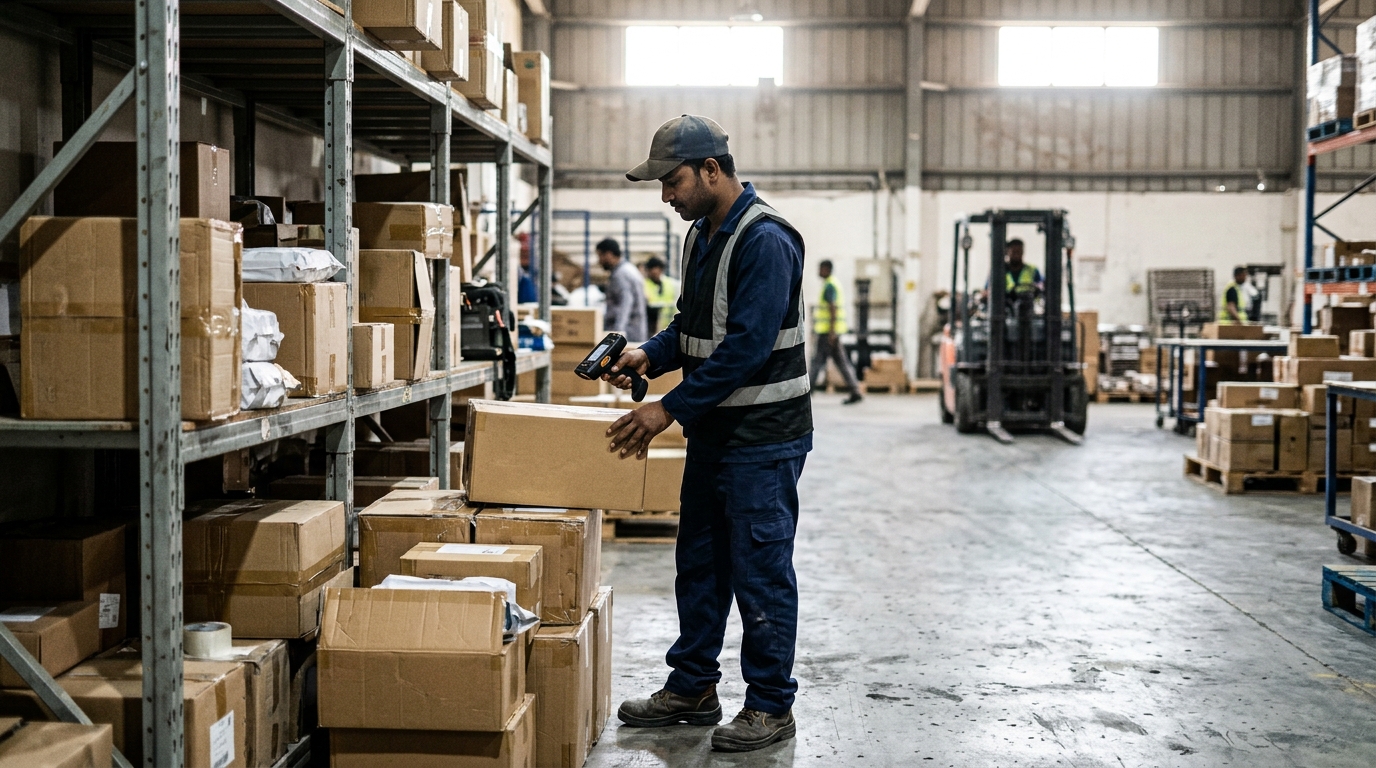
A warehouse associate in the UAE spends most of an eight-hour shift on their feet — unloading containers at the dock, counting and labelling stock, picking orders against a handheld scanner and packing them for dispatch. The delivery schedule and the outbound cut-off set the pace, so mornings are the heaviest part of the day.
Under Article 17 of Federal Decree Law No. 33 of 2021, private sector hours are 8 per day or 48 per week, reduced by two hours during Ramadan (The Official Portal of the UAE Government (u.ae), 2026-08-12). The work is indoors, repetitive and physical.
Hour-by-Hour Breakdown
A common pattern in a Dubai or Sharjah distribution warehouse running a 6am to 4pm day shift, with one unpaid hour off the clock.
6:00 AM — Briefing and PPE check. Ten to fifteen minutes: steel-toe boots, hi-vis vest and cut-resistant gloves on, the supervisor reads out the day's inbound containers and the dispatch cut-off, and forklift drivers confirm their certification is current.
6:20 AM — Goods-in. Roughly two hours receiving, inspecting and unloading incoming materials, spare parts and equipment, weighing and counting received items against the delivery note (Bayt.com). Expect to break down two to four pallets per container by hand and flag damaged cartons before the driver leaves.
8:00 AM — Putaway and labelling. About ninety minutes moving stock to designated locations, printing bin labels on a Zebra thermal printer and scanning each pallet in so the location goes live for pickers.
9:30 AM — Picking wave. The busiest 90 minutes of the morning, walking the aisles with a handheld scanner against a pick list. Precision in picking and packing customer orders is what the role is judged on (Bayt.com); a mis-pick found at packing means walking the aisle again.
11:00 AM — Break. A worker who works five consecutive hours is entitled to a break of not less than one hour, not counted within working hours (The Official Portal of the UAE Government (u.ae), 2026-08-12).
12:00 PM — Packing and dispatch. Two hours of boxing, void-filling, strapping and stretch-wrapping pallets, then applying airway bills. From 15 June to 15 September, work directly under the sun and in open places is banned between 12:30pm and 3pm (The Official Portal of the UAE Government (u.ae), 2026-08-12), so yard tasks shift in summer.
2:00 PM — Cycle counting. Forty-five minutes recounting assigned bin locations, investigating gaps between system and physical quantity, and raising adjustments for approval.
2:45 PM — Issuing against work orders. Picking components for an assembly team or a branch, as listed in warehouse assistant postings (Bayt.com), and getting a signature on the issue slip.
3:15 PM — Housekeeping. Flattening cartons, sweeping aisles, re-stacking empty pallets and removing warehouse trash — a standing duty in helper postings (Bayt.com), and the least popular half-hour of every shift.
3:45 PM — Handover. Scanners docked on charge, open discrepancies written up, pallet truck parked clear of the fire lane. A late container can mean up to two extra hours, the daily legal maximum for overtime (The Official Portal of the UAE Government (u.ae), 2026-08-12).
Tools and Equipment Used
- Handheld barcode scanner (Zebra MC3300 or similar rugged terminal) — in your hand for most picking and putaway hours.
- Hand pallet truck (pallet jack) — the default for moving loaded pallets across the floor.
- Counterbalance forklift and reach truck — for racking above shoulder height; a forklift operator certification is often required in Dubai warehouse assistant postings (Bayt.com).
- Inventory management software — experience with it is a stated requirement in those postings (Bayt.com); in practice a WMS such as SAP EWM, Oracle NetSuite WMS, Odoo Inventory or Zoho Inventory.
- Microsoft Excel — cycle count sheets, discrepancy logs, daily inbound trackers.
- Zebra ZT230 thermal label printer and label rolls — bin labels, carton labels, airway bills.
- Platform floor scale and bench scale — for weighing and counting received items (Bayt.com).
- Stretch wrap, strapping tool and PET strapping — pallet-building before dispatch.
- Retractable safety knife, marker pens, packing tape gun.
- PPE: steel-toe boots, hi-vis vest, cut-resistant gloves, hard hat in racking aisles.
- Sack truck and roll cages — for loose cartons and branch deliveries.
Work Environment and Pace
Most of the shift is indoors, in a high-bay steel-roofed shed in an industrial zone such as Jebel Ali, Al Quoz, Sharjah's industrial areas or Mussafah in Abu Dhabi. Ambient-temperature warehouses get genuinely hot from May to September once the dock doors are open; chilled and frozen sites run the other way and issue a freezer jacket. Noise is constant rather than deafening — forklift reversing alarms, shrink-wrap motors, the tape gun and trailer engines at the dock.
You are standing and walking for the bulk of the eight hours, lifting cartons roughly in the 5 to 25 kg range dozens of times a day, bending, reaching to top shelves and climbing in and out of containers. Screen time is limited to the handheld scanner and short spells at a terminal.
Normal hours are 8 per day or 48 per week (Ministry of Human Resources and Emiratisation), which in warehousing usually means six days rather than five. Overtime is capped at two hours a day at normal pay plus 25%, or plus 50% between 10pm and 4am; work on an off-day earns a substitute rest day or normal pay plus 50% (The Official Portal of the UAE Government (u.ae), 2026-08-12).
The tedious parts are real: clearing warehouse trash and flattening cartons every shift (Bayt.com), recounting the same slow-moving bin for the third time in a month to chase a one-unit variance, and re-labelling returns whose barcodes have been torn off. Peak weeks bring long stretches of pure picking with little variation.
How to Get Started
- Check the physical requirement honestly. Warehouse helper postings on Bayt.com ask for candidates who are physically fit and ready for general warehouse duties anywhere in the UAE. If you cannot stand and lift for a full shift, look at inventory clerk or data-entry roles in the same buildings.
- Sort out your work status. Entry-level warehouse jobs here are sponsored: the employer applies for the permit and registers the contract with MOHRE. Read the hours, overtime and accommodation clauses against the 8-hour, 48-hour standard in Federal Decree Law No. 33 of 2021, and check current requirements on the MOHRE website.
- Get a forklift operator certification. This is the credential that separates a helper from an operator, and Dubai warehouse assistant postings list it alongside accuracy in counting, labelling and verifying stock (Bayt.com). Train with a UAE-based lifting equipment training provider covering counterbalance and reach truck classes.
- Learn one inventory system plus Excel. Experience with inventory management software is explicitly asked for (Bayt.com). Free or trial editions of Odoo Inventory or Zoho Inventory let you practise receiving, putaway, picking and stock adjustments; Excel filtering and VLOOKUP cover the count sheets.
- Apply under every title the sector uses. Bayt.com lists Warehouse Associate, Warehouse Assistant, Warehouse Helper, Warehouseman, Warehouse Operator and Warehouse In-Charge — search all six, plus Picker Packer and Storekeeper, and check 3PL and e-commerce career pages.
- Prepare for a practical test. Interviews often include counting a part-pallet, reading a work order and showing safe lifting technique. Be ready to say what you can lift comfortably and whether you can work nights.
- Plan the next rung. Once you can run cycle counts and drive a forklift, the usual moves are Warehouse Operator, then Warehouse In-Charge (Bayt.com).
Frequently asked questions
How many hours will I actually work, and what about Ramadan?
Article 17 of Federal Decree Law No. 33 of 2021 sets normal private sector hours at 8 per day or 48 per week, reduced by 2 hours during Ramadan (The Official Portal of the UAE Government (u.ae), 2026-08-12). After five consecutive hours you are entitled to a break of at least one hour that is not counted within working hours, so a 6am start usually ends around 4pm.
How is pay usually structured for warehouse work in the UAE?
Contracts are normally a basic salary plus allowances such as accommodation and transport, with overtime on top at normal pay plus 25%, rising to plus 50% between 10pm and 4am, and off-day work earning a substitute rest day or normal pay plus 50% (The Official Portal of the UAE Government (u.ae), 2026-08-12). For current ranges, compare live Warehouse Associate and Warehouse Assistant listings on Bayt.com against the MOHRE-registered contract.
Do I need a forklift licence to get hired?
Not for a helper or picker role, but Dubai warehouse assistant postings often list forklift operator certification as a required skill alongside inventory management software experience (Bayt.com). Without it you stay on hand pallet trucks and ground-level picking.
Will I have to work outside in the summer heat?
Some loading and yard work is in the open. Under Ministerial Resolution No. 44 of 2022, work performed directly under the sun and in open places is not allowed between 12:30pm and 3pm from 15 June to 15 September each year (The Official Portal of the UAE Government (u.ae), 2026-08-12), so those tasks move to early morning or late afternoon.
What will I be doing in my first week?
Goods-in and putaway: receiving, inspecting and unloading incoming materials, spare parts and equipment, weighing and counting received items, then organising, labelling and storing them in designated locations (Bayt.com). You will also issue materials against work orders and clear warehouse trash at the end of each shift.
Sources
- The Official Portal of the UAE Government (u.ae) — Working hours and overtime (2026-08-12)
- Ministry of Human Resources and Emiratisation (MOHRE) — Dear Worker

Written by
Priya turns hiring numbers and salary surveys into readable stories about where opportunity is actually moving. She cares most about separating genuine shifts from recruiter spin.